

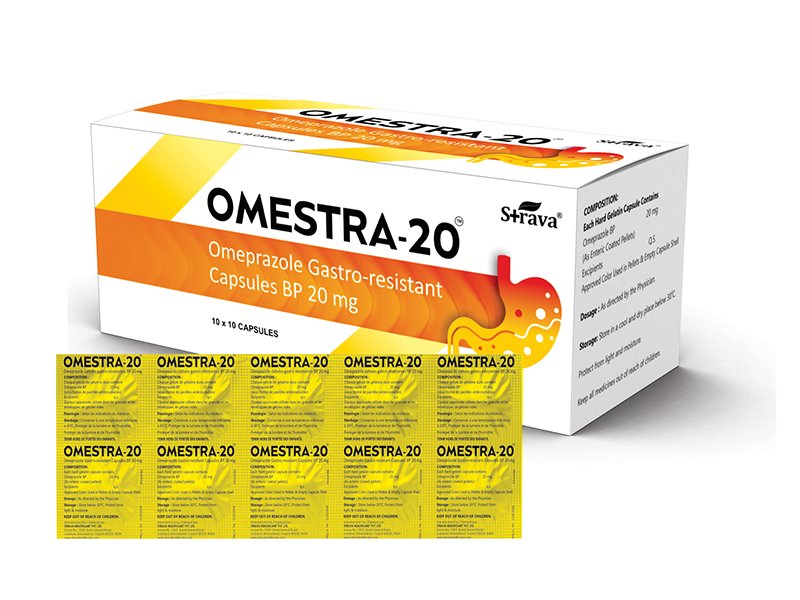
Indications
- Gastroesophageal reflux disease (GERD)
- Peptic ulcer disease, gastric and duodenal
- H. pylori eradication as part of triple therapy
- NSAID-associated ulcer prevention
- Zollinger-Ellison syndrome
Product Notes
For B2B and Pharma Partners
- Contract manufacturing with custom branding and pack configurations
- Private label omeprazole capsules, ready to market
- Bulk supply for distributors, hospital chains, and export
Product Specifications
| Parameter | Details |
|---|---|
Active ingredient | Omeprazole |
Strength | 20 mg, 40 mg |
Dosage form | Delayed-release capsule (enteric-coated pellets) |
Pack sizes | 10s, 14s blister; 100s, 500s bottle |
Storage | Below 25°C, away from moisture |
Shelf life | 24 months |
Manufacturer | Strava Healthcare Private Limited |
Frequently Asked Questions
It is advised to take 30 to 60 minutes before the first meal of the day. Proton pumps activate when food is on the way, so taking omeprazole just before eating gives it the best window to work. Swallowing it with breakfast and moving on is a common mistake you lose some of that timing advantage.
Short courses of 4 to 8 weeks are the standard starting point for GERD and ulcer treatment. Long-term use is clinically common but worth reviewing periodically — years of PPI use can reduce magnesium absorption, have modest effects on bone density, and slightly raise C. difficile risk. None of these is a reason to panic, but they are reasons not to just keep refilling indefinitely without checking whether the underlying problem still needs it.
Yes. Omeprazole inhibits CYP2C19, which is the enzyme that activates clopidogrel in the body. Less active clopidogrel means weaker platelet inhibition — a real concern in cardiac patients. Pantoprazole has a much smaller effect on CYP2C19 and is preferred when both drugs are needed.
The 20 mg is our standard format. The 40 mg is available on request for B2B clients. Get in touch with your volume and specification requirements.